
HydraFacial vs Regular Facial — The Real Difference
One costs ₹800. The other costs ₹3,000. But the gap between them isn't just money — it's like comparing a broom to a vacuum cleaner.
Get Expert AdviceLet's Start With What a "Regular Facial" Actually Is
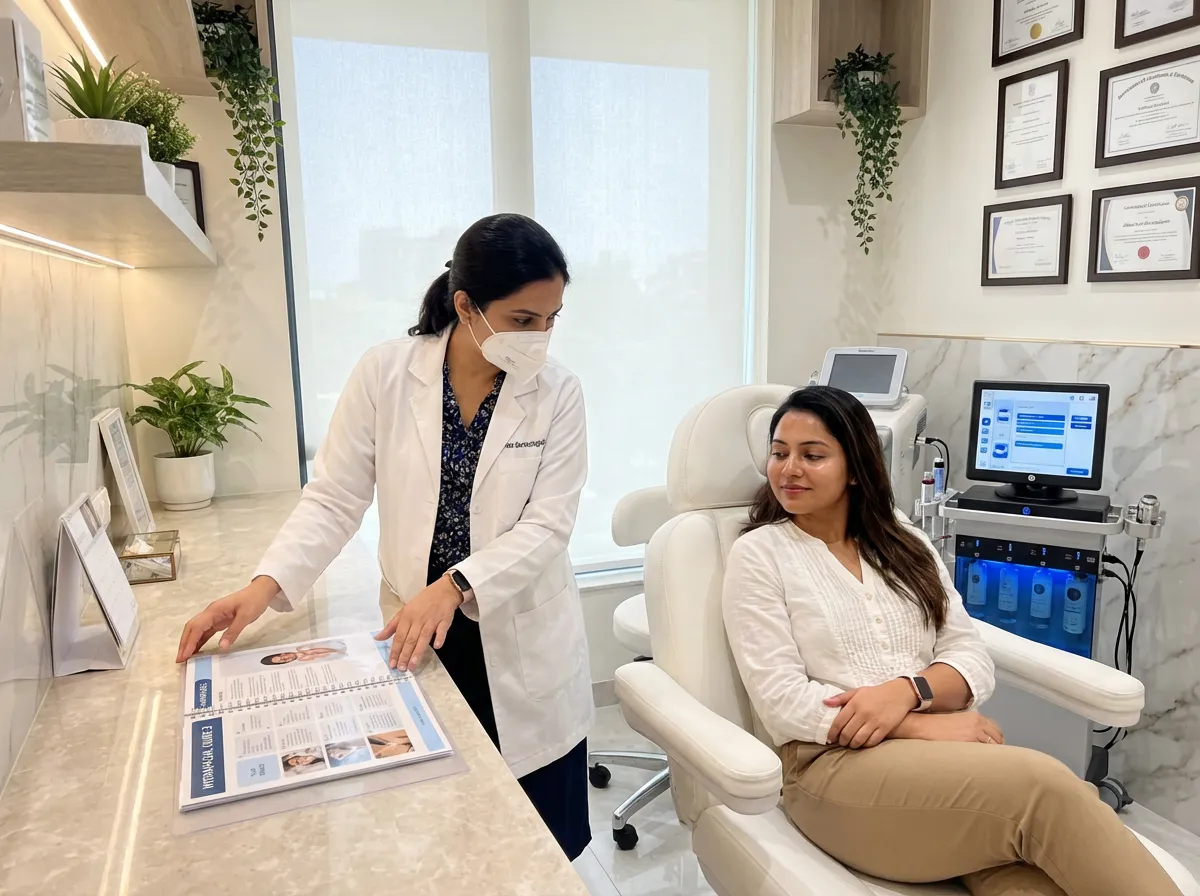
Walk into any salon in Aminabad, Hazratganj, or the dozens of beauty parlours scattered across Gomti Nagar — and ask for a "facial." You'll get some variation of this: cleansing, steaming, manual extraction (that part where someone squeezes your nose with their fingers), a fruit/chemical mask, and massage. Sometimes there's a random machine that vibrates. Nobody really knows what it does. Including, sometimes, the person operating it.
The products vary wildly — from medical-grade to stuff bought in bulk from Aminabad wholesale market. You don't know. You can't know. And that uncertainty is the first problem.
What HydraFacial Does Differently
HydraFacial is a closed-loop system. One machine, patented tips, medical-grade serums that come sealed. There's no room for substitution or dilution — what goes in is what goes in. The process is standardized: cleanse-peel, extract-hydrate, fuse-protect. Every time. Consistency that a salon treatment physically cannot match.
But the real differentiator is the vortex extraction. Instead of pressing and squeezing your pores (which can rupture capillaries and cause post-inflammatory pigmentation), the machine creates a gentle vacuum that sucks debris out. No trauma to the skin. No redness afterwards. No "my face broke out worse after the facial" stories.
The Comparison Table You Actually Need
| Factor | Regular Salon Facial | HydraFacial |
|---|---|---|
| Extraction | Manual (fingers/tool) — painful, can cause marks | Vortex suction — painless, no marks |
| Products | Varies by salon — generic to premium | Sealed, medical-grade, standardized |
| Serum penetration | Surface application (sits on top) | Forced infusion under vortex pressure |
| Customization | Same process for everyone | Different tips + boosters per skin type |
| Downtime | Sometimes redness, breakouts next day | None — walk out and go to an event |
| Hygiene | Shared tools, reused bowls | Single-use tips, disposable waste canister |
| Results duration | 2-3 days of "glow" | 7-10 days of visible improvement |
| Cost (Lucknow) | ₹500–₹1,500 | ₹2,500–₹5,000 |
The "Post-Facial Breakout" Problem
We hear this all the time at Gomti Clinic. "I got a facial last week and now my skin is worse." There's a name for this — it's called a facial reaction, and it happens for three reasons:
- Aggressive extraction — pushing bacteria deeper into pores instead of removing it
- Contaminated products or tools — introducing new bacteria onto freshly opened pores
- Comedogenic products — heavy creams or masks that clog freshly cleaned pores
HydraFacial sidesteps all three. The suction pulls out (doesn't push in), the tips are disposable (no cross-contamination), and the serums are non-comedogenic by formulation. This is why dermatologists recommend HydraFacial over salon treatments — not because we're snobs, but because the engineering is genuinely better.
When a Regular Facial Is Actually Fine
Honesty moment — because we're not here to say everything must be HydraFacial. A basic cleanup facial at a decent salon is perfectly acceptable if:
- You have clear skin and just want relaxation + mild cleansing
- You know the salon uses good products (ask to see the brands — genuinely ask)
- You don't have active acne, sensitivity, or pigmentation concerns
- Budget is tight — ₹800 monthly is more sustainable than ₹3,000 for many people
Not every skin concern requires a medical-grade solution. If your face is doing well and you enjoy the spa experience — a salon facial is fine. The problem arises when people with actual skin issues rely on salon facials as treatment. They're not treatment. They're maintenance — and sometimes, not even that.
What About "MediFacials" and "Oxy Facials"?
These are marketing terms, mostly. MediFacials are facials done at a clinic with better products — a step up from salon facials but not standardized. Oxy facials claim to infuse oxygen into your skin which — let's be medically honest — your skin gets oxygen from your blood, not from a nozzle spraying air at your face. The sensation is pleasant. The science is questionable.
HydraFacial is the only facial system with published clinical data supporting its claims. Not because everything else is useless, but because HydraFacial is the only one that invested in proving their technology works. There's something to respect about that, even from a purely rational standpoint.
The Real-World Test
We occasionally do this at Gomti Clinic — with the patient's permission, obviously. HydraFacial on one cheek, nothing on the other. After 30 minutes, look at both sides under magnification. The difference in pore clarity, hydration level, and surface smoothness is visible to the naked eye. Not dramatic-movie-transformation visible. But clearly, tangibly different.
Try asking your salon to do the same test with their regular facial. The difference will be... less convincing.
Frequently Asked Questions
Can I alternate between salon facials and HydraFacial?
Yes — you could do HydraFacial every other month and a salon cleanup in between. That keeps the cost manageable while still getting the deep extraction benefit regularly. Just make sure the salon facial happens at least 2 weeks apart from your HydraFacial session.
Why is HydraFacial more expensive?
The machine itself costs ₹15-20 lakhs. The tips and serums are consumables that must be purchased from the manufacturer — no substitutions. The technology license and maintenance add ongoing costs. Your salon uses products that cost ₹200 per session in materials. HydraFacial's materials cost ₹800-1,200 per session. That cost gets passed on.
Is HydraFacial worth 3x the price?
If you have skin concerns that need addressing — blackheads, dullness, congestion, early aging — yes. Results-per-rupee, HydraFacial delivers more improvement. If you have perfect skin and just want pampering — a nice salon facial is honestly fine.